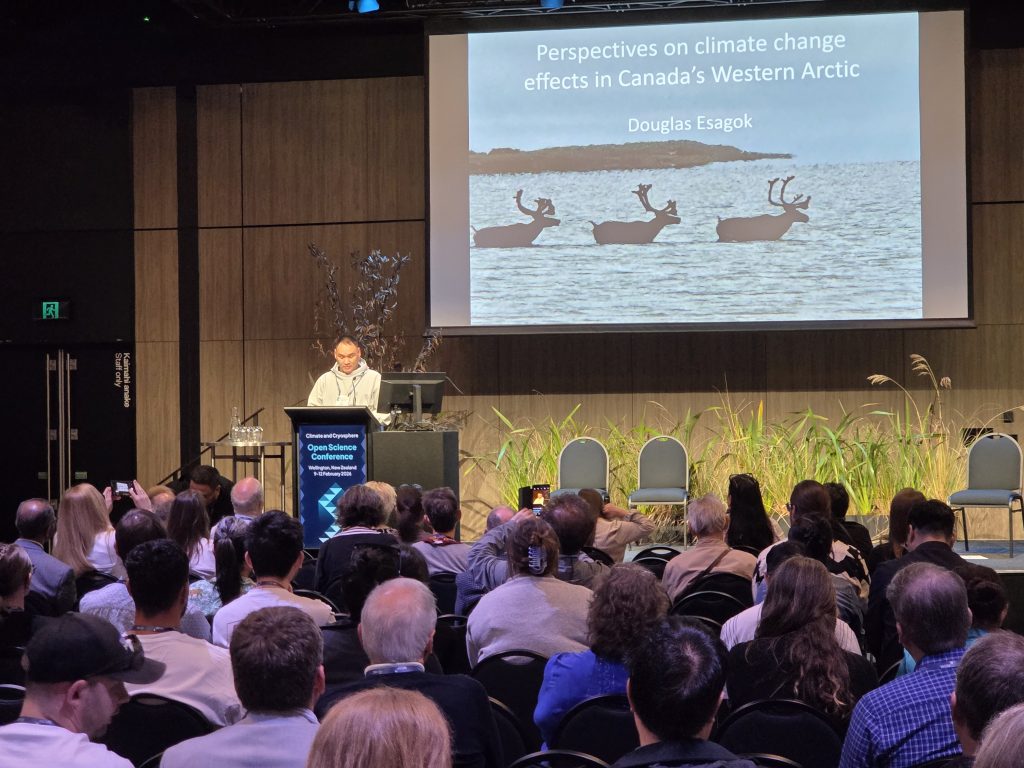
Climate and the Cryosphere (CliC) is a scientific steering group of the World Meteorological Organization’s World Climate Research Program. Last month, CliC held an Open Science Conference (OSC) in Wellington, attended by over 400 people from 37 countries. The conference was a pan-cryospheric gathering focused on “The Changing Cryosphere: Science, Impacts, and Adaptation”. The primary emphasis of CliC’s work in the last decade has been on the ice sheets of Antarctica and sea ice. The societal consequence of greatest concern has been sea level rise. In the last two years, especially, the CliC committee has recognized that change in the cryosphere is directly affecting communities in high mountains and in permafrost environments. The IPA co-sponsored the OSC. We provided one of the opening plenary speakers, a special session, contributions to the poster sessions, and held two special meetings.
Our most prominent contribution was the opening talk presented by Douglas Esagok of the Inuvialuit Game Council, Perspectives on climate change effects in Canada’s western Arctic. Doug is well known to the permafrost community working in the western Arctic. He is a hunter, trapper, and reindeer herder, whose personal observations of changes to the permafrost landscape due to climate change in the last 30 years were presented from the perspective of a person who is on the land daily. He described and presented data from four aspects of work in which he has been a key participant: monitoring permafrost conditions; observing development of disturbances; reporting incidences of landslides; and studying the death of vegetation, all in the Mackenzie delta area, and all associated with the changing cryosphere. It was an outstanding example of co-production of scientific knowledge resonating across the theme of the opening session of the conference. Doug’s attendance was enabled by the conference and co-sponsors Polar Knowledge Canada and the CPA.
The IPA’s special session was balanced to represent our capacity in science and engineering and the diverse geographical and societal nature of our community. The invited speakers gave precise and detailed talks that stimulated many questions. The presentations were by Sunil Kumar De (India), President of our partner the International Association for Geomorphology, Elizaveta Sharaborova (ECR, Switzerland), Ed Yarmak (USA), Ryley Beddoe (Canada), Nitin Chaudhary (Sweden), and Annett Bartsch (Austria). Earl de Guzman (Canada) spoke in the Special Session on Hazards and Infrastructure. Together, these presentations covered the sustainability of community and transportation infrastructure (Ed, Ryley, Earl), including in high mountains (Sunil), permafrost thermal regimes, again in high mountains (Elizaveta), carbon dynamics (Nitin), and teleconnections in Northern Hemisphere climate affecting permafrost (Annett).
The IPA also sponsored two early evening workshops, at the first we heard synopses of posters from Sunil Kumar De (India), Robyn Starycki (Canada), Piotr Owczarek (Poland), Hristo Popov (Bulgaria), Astrid Schetselaar (Canada), Kai Yang (China), and Chris Burn (Canada). This workshop, held the night before the poster session, acted as a permafrost ice breaker for us to meet each other outside the formal sessions. The second workshop featured a very interesting, invited presentation by Jon Tunnicliffe, the senior permafrost scientist of New Zealand, on the impact of thaw slump development on sediment budgets in NW Canada.
CliC is conscious that permafrost issues have been under-represented in its recent activities, notwithstanding its support for the Permafrost Carbon Network. The CliC committee will support an activity tied to community sustainability from 2027, and this year we must develop plans that may be contained within the budget constraints faced throughout the WMO. More details on this initiative will be published as they become available.
Provided by Chris Burn and Ed Yarmak
IPA Executive Committee